Fox validator lost without reason 3 million and sustaining fast upgrade and using high service platforms like AWS ….
1 Like
There is a nice tool track…and you can see we have so much good validators even losing les s blocks then company validstors and they are 30-50
1 Like
I like the idea of whitelist validators by the foundation as sign for good quality….but saying 30-50 ate bad validators is the exact opposite of whitelisting quality validators….
Firstly, the foundation approach is totally different from what I mentioned months ago.
- Limiting to top 30 or 40 does not solve the core issue.
Whitelisting means verifying each validator based on performance and performance only. There are sub-categories to this, such as reputation and effort put into marketing their validator’s services.
The only thing I can do is give feedback; whether Baklava apply it is out of my control.
2 Likes
I know @SCENE this is why I said I like your idea from ago by whitelisting quality work by foundation…
It’s obvious that you don’t make the decisions on delegations by baklava or Fx foundation
While I can understand their initial approach of selecting all top 50 validators to capture most of the community’s support, this is short-term approach that will backfire in the event that someone goes rogue and funds get slashed.
Which is why I said to never forgo basic measures.
- Performance
- Reputation
- Effort
3 key points that I echo even in the core team of Cosmos.
1 Like
The current approach by redelegsting from 30-50 to 1-30 also kills the decentralization
1 Like
Decentralization is part of the later stages of any protocol - 99% of all projects are centralized. This is the harsh truth that most people fail to understand.
A protocol’s first priority should always be security and quality.
- Decentralization can always come later.
Again, I reiterate the 3 points that should come first for whitelist/verification.
- Performance
- Reputation
- Effort
If a project wants to be known as premium, it has to take the premium route. There’s no shortcut.
2 Likes
I 100% sign your approach @SCENE
@JohnB thats why I ask you and @indra to trust my fox validator as it always sustained high quality outwork and I’m well known since 2017/2018 in the community.
Even that fox validator is my private one I’m using it for the fox project to refund the project and using it to cover operational costs. I think a lot of people including me of course would love to see the foxes back on track. Currently we plan to reopen and hope for future grow of Fx ecosystem that we can earn our costs by our self.
1 Like
I was chatting with some of the Chainlink folks, and they echo the same points.
Nodes and validators are like running a business. Validators have to do BD and marketing to attract consumers to your services. You are an independent contractor; you have to actively manage it.
Anyway, my feedback has been given. Peace.
2 Likes
Someone please explain how being in the Top 30 ensures you have the least slashing risk? What kind of evaluation criteria is this ? @indra @SCENE
Alif has dropped from rank 25 to 38 over the last year. I would like someone to explain where do we fall short of security or performance.
Public validators don’t have enough voting power to meet 40% quorum, and as a result of this decision, Singapore, European Univeristy and Litecoin foundation got 15 mil more delegations. They never participate in voting, this is killing decentralization.
Higher ranking doesn’t mean lower the risk of getting slash, delegating to lower ranking validator can promote decentralization and enhance stablity of the network 
1 Like
Hello sir,
I understand the risk of which you guys speak… I worry about it a lot too reading through the telegram conversation and hearing the sort of questions some of our validator runners ask… No disrespect to anyone but we could all use a lot of learning about Linux systems in general and how to navigate through it… as well as understanding how networking works and what a node and validators roles are and how to run them properly.
What I don’t understand is, what has Alif done as a validator to make anyone from the team or community feel that we have undermined security in any way or whether we’ve ever been late on updates.
I feel that the decision to re-delegate based solely on the fact that the validators are in top 30 and then somehow linking that to their ability to run the validators and security is short sighted.
We at Alif are working extremely hard to ensure the safety of the network is held to the utmost standard and no compromises are made. For this reason we even had to make the difficult decision of raising our commision to cover safety and security costs.
With all that said, I would love to hear your guys thoughts on what makes the top 30 so secure ?
Hi @l4zyboi
The decision to focus on top 30 but not top 50 is Baklava Space’s decision, not the anyone else’s. My speculation is that it is easier for maintenance on their end because if a validator drop out of top 50 they have to redelegate their vault because their work is about farming aka profit-maximzation for staker.
What we the community can do is to try to allocate more of our personal share and foundation share to the the really outstanding ones - especially those not user the baklava redelegation top 30.
I also agree w u that if a validator should be well-run, solid linux knowledge should be a must.
1 Like
Hi @SiverSurfer
It was NOT Baklava team’s decision. Read the attached screen shot and get your facts straight!
And explain this criteria which helps you find “Really Outstanding” validators. Because Alif would love to learn from these criteria’s and improve if we are lacking.
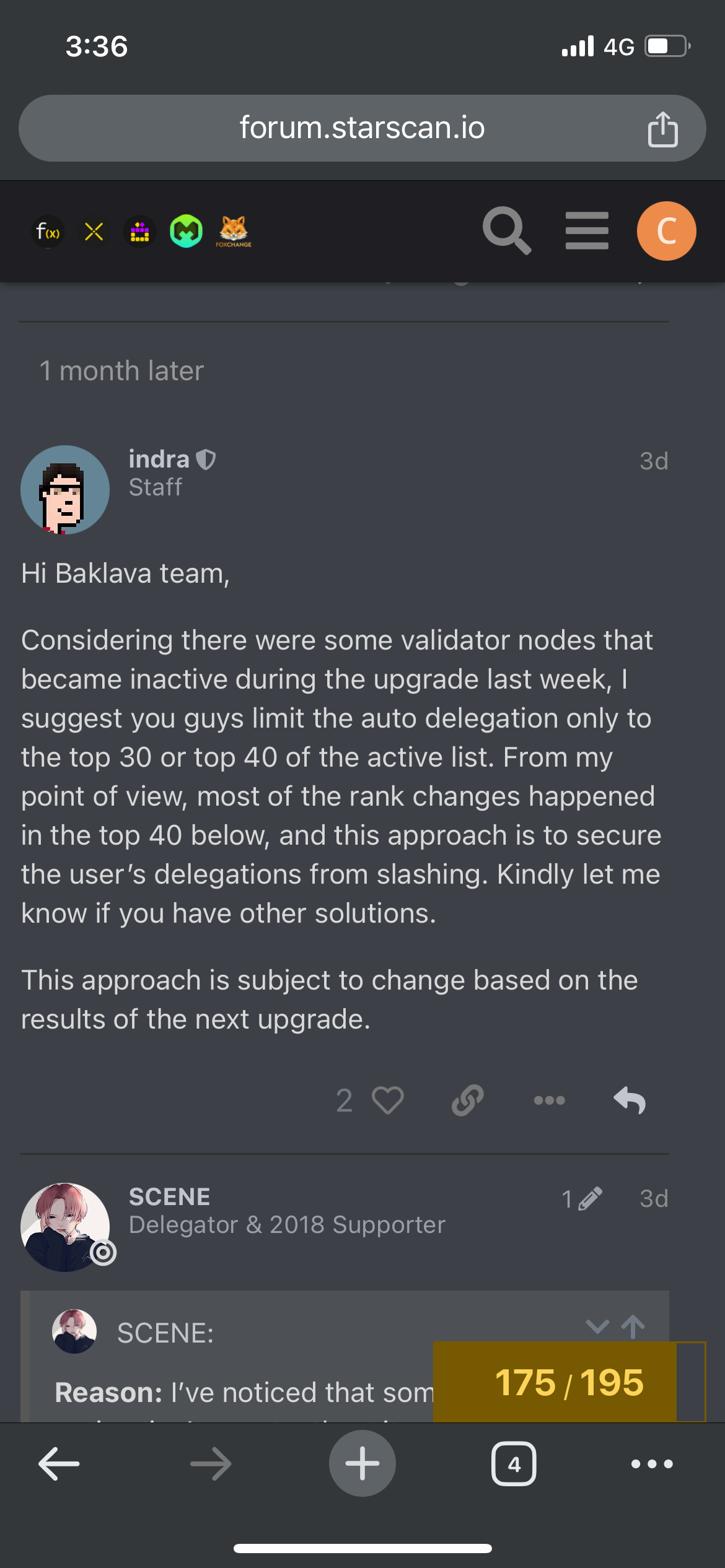
What I do know is, this decision relegated 15 million to European University, Litecoon and Singapore. All of them don’t participate in votings, so good job improving decentralization. Definitely a step in the right direction.
2 Likes
- To all community validators, this is my personal opinion.
I would like to add a point that all independent validators who want to increase their stake should start marketing and let the community understand why they should trust and delegate to you.
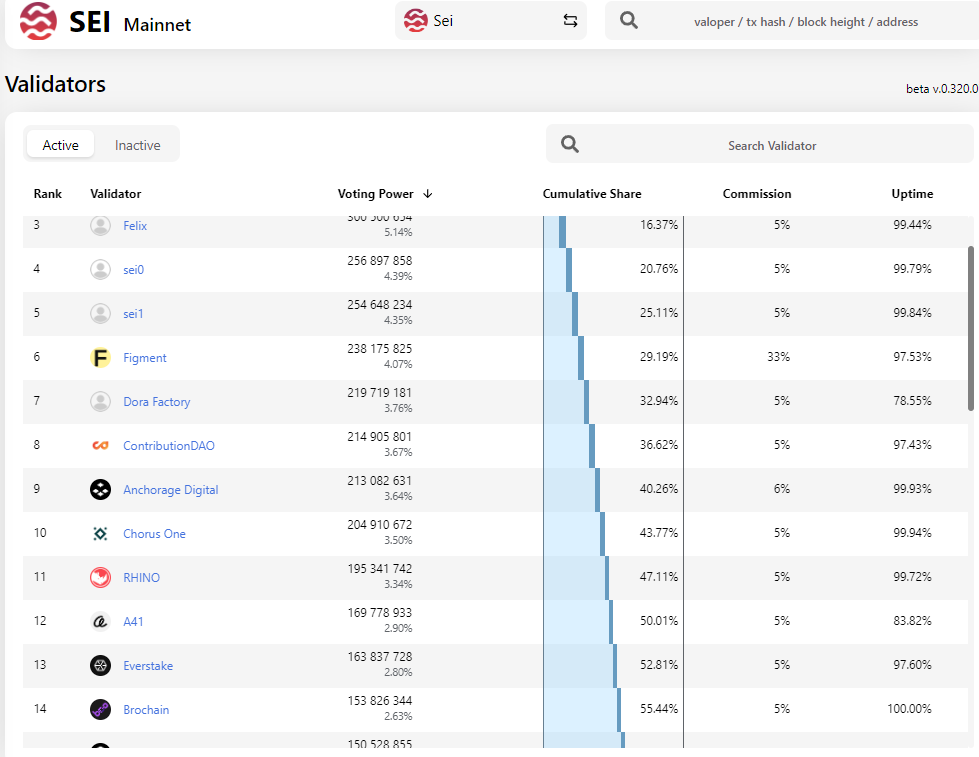
Reference Sei and many other new blockchains - all the active validators are professionals ONLY.
- Please understand this:
Retail users are known to select trustworthy organizations or service providers; if you go to another blockchain, it is highly likely you won’t even have a single delegate serving as an independent validator.
Our community validators, in my opinion, are beginning to feel so self-entitled that they believe their delegation should grow without needing to do any marketing or make it clear to the public why they should pick you over experts.
The Foundation, in my opinion, has given everyone a sizable amount that they should have been giving to the service providers, don’t abuse their goodwill by taking advantage of it. The current track record proves itself: there are more community validators who have been jailed or downtime compared to real service providers.
I believe that from now onwards, there needs to be a clear standard guideline to avoid these types of issues.
- Performance
- Reputation ( Why should regular users trust you over professionals? )
- Effort ( What effort are you making to attract delegators? )
Beyond the 3 key points, there should be 2 phases as well.
- Evaluation phase - The company or projects like Baklava should evaluate each validator based on their performance and efforts with a timeline of like ~6 months. After this period, delegation should be adjusted based on performance and effort made.
- Maintenance phase - Community validators should continue to put in effort to attract delegators and show that they have the capability to handle tough situations.
Validators are in charge of the user’s money; therefore, validators should have a certain standard of commitment.
1 Like
Scene I would totally agree with the marketing strategy if the funds were community funds.
This is literally the team picking favourites. We are just trying to understand what the criteria of being picked is ?
What has Alif done to lose the trust of the team in any way shape or form ?
l4zyboi quoted: I would totally agree with the marketing strategy if the funds were community funds.
This does not make any sense.
- Service providers or institutions don’t require community funds to market (your validation services is your responsibility)
- Validators in ANY blockchain have never used CSP or EGF to market or attract delegators
Do you see Ethereum node services asking the Ethereum Foundation for money to fund marketing activities? Validation services are one’s own responsibility.
Regarding the top 30 situation, that is why I suggested “Performance-based criteria” - the 3 key points instead of top 30.
Getting integrated into a protocol should be based on those 3 points, the standard criteria for all projects in every blockchain. Reference Lido and many others. It’s called Whitelist for a reason.
- There has to be a clear standard guideline.
- Validators should continue to put in effort to attract delegators - re-adjust if no effort made
- There is zero reason to trust independent validators over professionals, this is money we are talking.
1 Like